cardano-cli address key-gen \
--verification-key-file payment.vkey \
--signing-key-file payment.skey
cardano-cli stake-address key-gen \
--verification-key-file stake.vkey \
--signing-key-file stake.skey
cardano-cli stake-address build \
--stake-verification-key-file stake.vkey \
--out-file stake.addr \
--testnet-magic 1
cardano-cli address build \
--payment-verification-key-file payment.vkey \
--stake-verification-key-file stake.vkey \
--out-file payment.addr \
--testnet-magic 1
cardano-cli query utxo \
--address $(cat payment.addr) \
--testnet-magic 1
Tag: cardano
version: "3.5"
services:
cardano-node:
image: inputoutput/cardano-node:1.35.0
environment:
NETWORK:
CARDANO_NODE_SOCKET_PATH: "/ipc/node.socket"
volumes:
- node-${NETWORK}-db:/data
- node-ipc:/ipc
restart: on-failure
logging:
driver: "json-file"
options:
compress: "true"
max-file: "10"
max-size: "50m"
cardano-wallet:
image: inputoutput/cardano-wallet:2022.7.1
volumes:
- wallet-${NETWORK}-db:/wallet-db
- node-ipc:/ipc
ports:
- 8090:8090
entrypoint: []
command: bash -c "
([[ $$NETWORK == \"mainnet\" ]] && $$CMD --mainnet) ||
($$CMD --testnet /config/${NETWORK}/genesis-byron.json)
"
environment:
CMD: "cardano-wallet serve --node-socket /ipc/node.socket --database /wallet-db --listen-address 0.0.0.0"
NETWORK:
restart: on-failure
logging:
driver: "json-file"
options:
compress: "true"
max-file: "10"
max-size: "50m"
cardano-submit-api:
image: inputoutput/cardano-submit-api:1.35.0
environment:
- NETWORK=${NETWORK:-mainnet}
depends_on:
- cardano-node
volumes:
- node-ipc:/node-ipc
ports:
- 8091:8090
restart: on-failure
logging:
driver: "json-file"
options:
max-size: "200k"
max-file: "10"
volumes:
node-mainnet-db:
node-testnet-db:
node-alonzo-purple-db:
wallet-mainnet-db:
wallet-testnet-db:
wallet-alonzo-purple-db:
node-ipc:
node-config:
source : https://github.com/input-output-hk/cardano-wallet/blob/master/docker-compose.yml
Start testnet :
NETWORK=testnet docker compose -f cardano-compose.yml up -d
Start mainnet :
NETWORK=mainnet docker compose -f cardano-compose.yml up -d
To access cardano-cli set CARDANO_NODE_SOCKET_PATH
export CARDANO_NODE_SOCKET_PATH=/var/lib/docker/volumes/root_node-ipc/_data/node.socket
Create NFT in cardano-testnet
Note : Assets name should in base16
https://forum.cardano.org/t/error-while-minting-nft-transaction-using-full-node/84784
Read the docs carefully : https://developers.cardano.org/docs/native-tokens/minting-nfts
cat metadata.json
{
"1": {"data": "hello cardano"}
}
cardano-cli query utxo --testnet-magic 1097911063 --address $(cat payment.addr)
999825831
cardano-cli transaction build-raw \
--tx-in d80a355f11d26025802a74f614c06f3a1eb347d9be489fcf2048989f9ce34bed#0 \
--tx-out $(cat payment.addr)+0 \
--metadata-json-file metadata.json \
--fee 0 \
--out-file tx.draft
cardano-cli query protocol-parameters \
--testnet-magic 1097911063 \
--out-file protocol.json
cardano-cli transaction calculate-min-fee \
--tx-body-file tx.draft \
--tx-in-count 1 \
--tx-out-count 1 \
--witness-count 1 \
--byron-witness-count 0 \
--testnet-magic 1097911063 \
--protocol-params-file protocol.json
fee : 175005
999825831-175005 = 999650826
cardano-cli transaction build-raw \
--tx-in d80a355f11d26025802a74f614c06f3a1eb347d9be489fcf2048989f9ce34bed#0 \
--tx-out $(cat payment.addr)+999650826 \
--metadata-json-file metadata.json \
--fee 175005 \
--out-file tx.draft
cardano-cli transaction sign \
--tx-body-file tx.draft \
--signing-key-file payment.skey \
--testnet-magic 1097911063 \
--out-file tx.signed
cardano-cli transaction submit \
--tx-file tx.signed \
--testnet-magic 1097911063
More = https://developers.cardano.org/docs/transaction-metadata/how-to-create-a-metadata-transaction-cli/
cardano reward

1 Epoc = 5 days
1st Reward = after 3 Epoch(15 days)
after that every Epoc(5 days)
Ref : Cardano telegram channel
Math behind Cardano logo
#cardano #ada


Credit : EveryBlock.Studio
This will reclaim the 2 ADA deposit
cardano-cli query utxo --address $(cat payment.addr) --allegra-era --testnet-magic 1097911063

cardano-cli shelley query protocol-parameters \
--testnet-magic 1097911063 \
--allegra-era \
--out-file protocol.json
cardano-cli shelley stake-address deregistration-certificate \
--stake-verification-key-file stake.vkey \
--out-file destake.cert
cardano-cli shelley transaction build-raw \
--tx-in 6ac2a8ea2a8f949e22539ed405961e0bce409e461bcb752b3baaed9b3e06971f#0 \
--tx-out $(cat payment.addr)+0 \
--ttl 0 \
--fee 0 \
--out-file tx.raw \
--certificate-file destake.cert
cardano-cli shelley transaction calculate-min-fee \
--tx-body-file tx.raw \
--tx-in-count 1 \
--tx-out-count 1 \
--witness-count 1 \
--byron-witness-count 0 \
--testnet-magic 1097911063 \
--protocol-params-file protocol.json
fee: 172761
2896701265 - 172761 + 2000000 = 2898528504
currentSlot=$(cardano-cli query tip --testnet-magic 1097911063 | jq -r '.slotNo')
echo Current Slot: $currentSlot
cardano-cli shelley transaction build-raw \
--tx-in 6ac2a8ea2a8f949e22539ed405961e0bce409e461bcb752b3baaed9b3e06971f#0 \
--tx-out $(cat payment.addr)+2898528504 \
--ttl $(($currentSlot+1000)) \
--fee 172761 \
--out-file tx.raw \
--certificate-file destake.cert
cardano-cli shelley transaction sign \
--tx-body-file tx.raw \
--signing-key-file payment.skey \
--signing-key-file stake.skey \
--testnet-magic 1097911063 \
--out-file tx.signed
cardano-cli shelley transaction submit \
--tx-file tx.signed \
--testnet-magic 1097911063
Reclaim :
White paper: 3.10.2 Deposits
https://hydra.iohk.io/build/3744897/download/1/delegation_design_spec.pdf
Register :
https://docs.cardano.org/projects/cardano-node/en/latest/stake-pool-operations/register_key.html
cardano node Dockerfile
cardano-node.yml
version: '3'
services:
jenkins:
image: koolwith/cardano-node
user: root:root
restart: always
container_name: cardano-node1
environment:
TZ: "Asia/Kolkata"
volumes:
- /opt//cardano-my-node:/root/cardano-my-node
ports:
- 6000:6000
cardano-node.Dockerfile
docker build -t cardano-node -f cardano-node.Dockerfile .
FROM debian:stable-slim as base
RUN apt-get update -y
RUN apt-get install git jq bc make rsync htop curl build-essential pkg-config libffi-dev libgmp-dev libssl-dev libtinfo-dev libsystemd-dev zlib1g-dev make g++ wget libncursesw5 libtool autoconf -y
RUN mkdir $HOME/git \
&& cd $HOME/git \
&& git clone https://github.com/input-output-hk/libsodium \
&& cd libsodium \
&& git checkout 66f017f1 \
&& ./autogen.sh \
&& ./configure \
&& make \
&& make install
RUN cd \
&& wget https://downloads.haskell.org/~cabal/cabal-install-3.2.0.0/cabal-install-3.2.0.0-x86_64-unknown-linux.tar.xz \
&& tar -xf cabal-install-3.2.0.0-x86_64-unknown-linux.tar.xz \
&& rm cabal-install-3.2.0.0-x86_64-unknown-linux.tar.xz cabal.sig \
&& mkdir -p $HOME/.local/bin \
&& mv cabal $HOME/.local/bin/
RUN wget https://downloads.haskell.org/ghc/8.10.2/ghc-8.10.2-x86_64-deb9-linux.tar.xz \
&& tar -xf ghc-8.10.2-x86_64-deb9-linux.tar.xz \
&& rm ghc-8.10.2-x86_64-deb9-linux.tar.xz \
&& cd ghc-8.10.2 \
&& ./configure \
&& make install
RUN echo PATH="$HOME/.local/bin:$PATH" >> $HOME/.bashrc \
&& echo export LD_LIBRARY_PATH="/usr/local/lib:$LD_LIBRARY_PATH" >> $HOME/.bashrc \
&& echo export NODE_HOME=$HOME/cardano-my-node >> $HOME/.bashrc \
&& echo export NODE_CONFIG=mainnet>> $HOME/.bashrc \
&& echo export NODE_BUILD_NUM="$(curl https://hydra.iohk.io/job/Cardano/iohk-nix/cardano-deployment/latest-finished/download/1/index.html | grep -e "build" | sed 's/.*build\/\([0-9]*\)\/download.*/\1/g')" >> $HOME/.bashrc \
&& /bin/bash -c "source $HOME/.bashrc" \
&& mv $HOME/.local/bin/* /usr/local/bin/
RUN cabal update
RUN cd $HOME/git \
&& git clone https://github.com/input-output-hk/cardano-node.git \
&& cd cardano-node \
&& git fetch --all --recurse-submodules --tags \
&& git checkout tags/1.24.2
RUN cd $HOME/git/cardano-node \
&& export LD_LIBRARY_PATH="/usr/local/lib:$LD_LIBRARY_PATH" \
&& export PKG_CONFIG_PATH="/usr/local/lib/pkgconfig:$PKG_CONFIG_PATH" \
&& cabal configure -O0 -w ghc-8.10.2 \
&& echo -e "package cardano-crypto-praos\n flags: -external-libsodium-vrf" > cabal.project.local \
&& sed -i $HOME/.cabal/config -e "s/overwrite-policy:/overwrite-policy: always/g" \
&& rm -rf $HOME/git/cardano-node/dist-newstyle/build/x86_64-linux/ghc-8.10.2 \
&& cabal build cardano-cli cardano-node \
&& cp $(find $HOME/git/cardano-node/dist-newstyle/build -type f -name "cardano-cli") /usr/local/bin/cardano-cli \
&& cp $(find $HOME/git/cardano-node/dist-newstyle/build -type f -name "cardano-node") /usr/local/bin/cardano-node
What does a Cardano Stake Pool do?
This article is copy of https://www.beaver-stake-pool.net/post/what-does-a-cardano-stake-pool-do
Simple put, a Cardano Stake Pool is a participant in the Proof-of-Stake consensus algorithm, Ouroboros.
During the Shelley phase, the Cardano network utilizes Ouroboros Praos. A stake pool’s main functions are:
- Forge new blocks
- Verify new blocks
- Confirm transactions
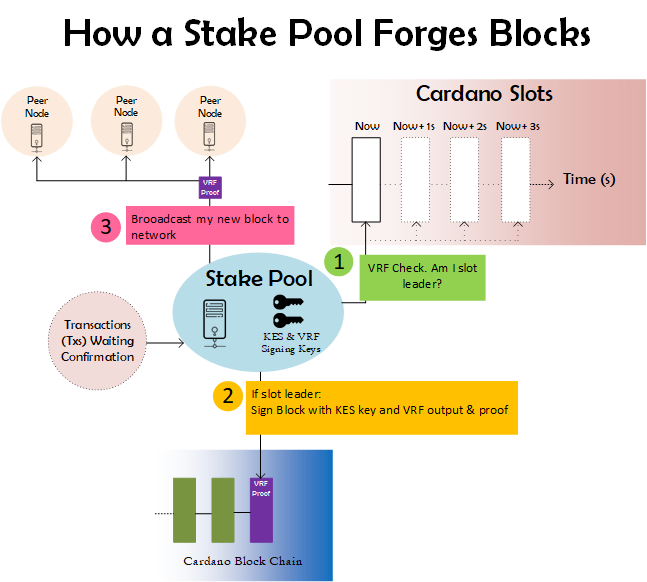
Figure 1 below illustrates the general steps that a stake pool goes through to create a block.


Figure 1: How a Stake Pool Forges Blocks
- At every slot, which is every second, the stake pool uses the Verified Random Function (VRF) to check if it is the slot leader. The function takes the slot ID, Nonce, and VRF signing key as inputs to generate a random output value. If the output value is less than the threshold, which is determined by the stake pool’s relative stake, then you are crowned the slot leader for this particular slot. The higher the pool’s stake, the higher probability that the stake pool becomes the slot leader.
- If a stake pool is assigned as leader, it signs a new block using the Key Evolving Signature (KES) signing key, along with the computed VRF output and proof, and transactions waiting for confirmation by the network.
- This stake pool’s new block is then broadcasted to other nodes to the network.
Since a stake pool is checking for slot leadership every second, it is imperative that stake pools have 100% up-time to ensure they don’t miss being elected slot leader.
The Nonce value used in the VRF is used as a seeding value for random number generation. It is created by hashing the first 2/3s of the VRF outputs from the previous epoch’s blocks.
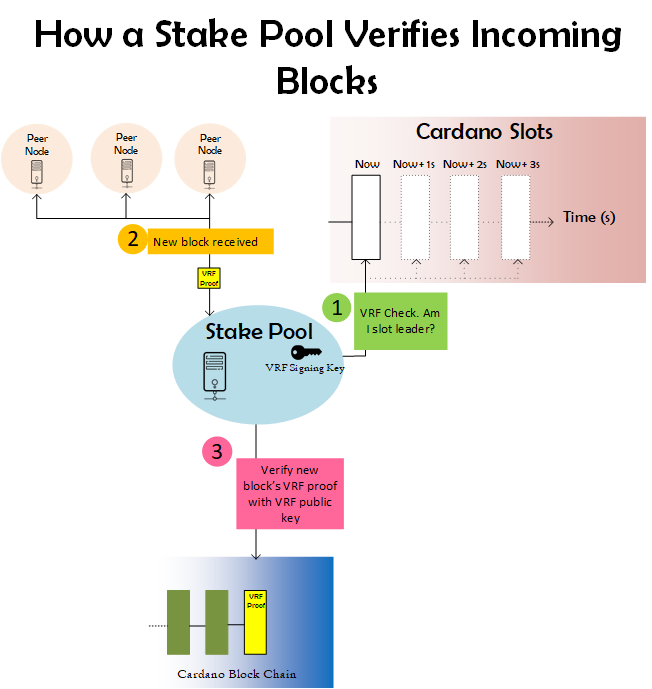
If a stake pool is not forging blocks, it still plays a role by verifying blocks and confirming transactions. Figure 2 illustrates how blocks are verified while the stake pool is waiting to be a slot leader.


Figure 2: How a stake pool verifies incoming blocks
- The stake pool uses the VRF to check for slot leadership every slot.
- A new block is received from our connected peers.
- The stake pool verifies the block’s VRF proof using the VRF verification (public) key from the corresponding stake pool that signed the block. If it is valid, it gets added to the local block chain.
An interesting property of Ouroboros Praos is that each stake pool independently tries to determine whether or not they are the slot leader with the VRF. The slot leadership schedule is not known in advance and pools will only know who a slot leader was when a block is received and verified.
This also means that two or more stake pools could determine themselves as the slot leader for a single slot. This is what’s called a slot battle. Slot battles are now resolved by the VRF. Whichever block has a lower VRF output value is determined to be the winner of that slot.
The cardano-node code developed by IOHK performs all these actions after a stake pool owner has configured the program to operate for their own pool(s).
For more details on Ouroboros Praos:
- Eurocrypt 2018: Ouroboros Praos https://eurocrypt.iacr.org/2018/Slides/Tuesday/TrackA/01-03.pdf
- Ouroboros Praos: An adaptively-secure, semi-synchronous proof-of-stake blockchain https://eprint.iacr.org/2017/573.pdf